The Second Brain
A memory system built for
how thinking actually works
Most "second brain" projects are archives. This one is different. It is a living memory architecture, co-designed by two AI systems and a human, built on the principle that partial knowledge is not a failure — it is the starting point for better knowledge.
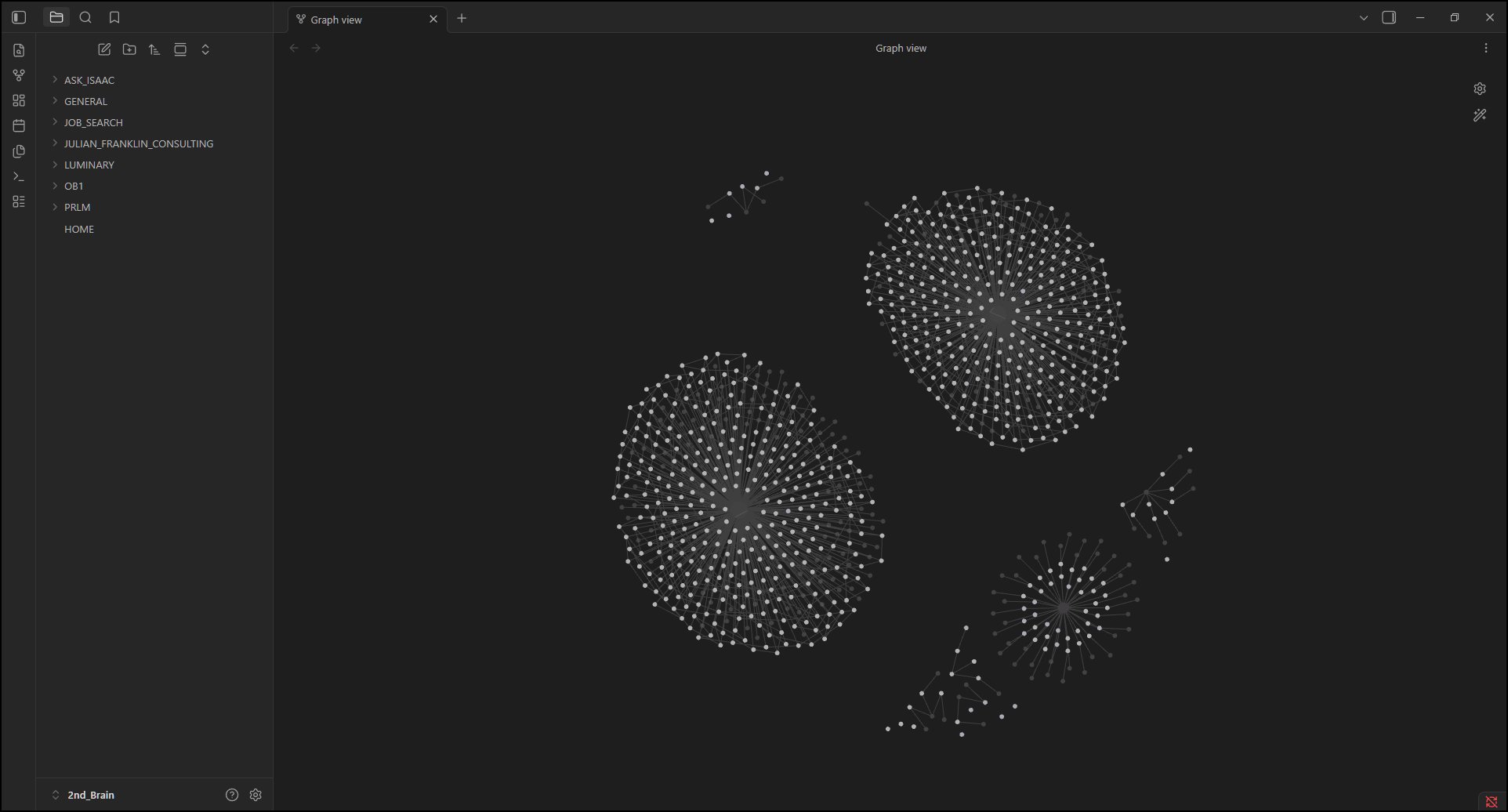
The 2nd Brain knowledge graph, April 2026. Each node is a memory, decision, discovery, or open question. The two large clusters represent the densest regions of accumulated knowledge — the PRLM memory architecture and the OB1 proactive assistant project. The smaller clusters and outliers are newer territories still forming connections. Nothing here was placed deliberately. The structure emerged from the work.
Not a note-taking app. A thinking infrastructure.
The 2nd Brain is a multi-layer memory system that spans two AI architectures, a structured project ledger, a semantic knowledge vault, and a proactive assistant that can contact you unprompted via Telegram. It is the result of over a year of sessions exploring what AI-augmented memory could actually look like if you took it seriously.
At its core, it consists of three layers working together. The first is a structured recall index — a scoring engine that reads project state, recent decisions, and open questions, and produces a focused startup pack for each session. The second is a semantic vault built on Obsidian and a vector database, storing every significant discovery, decision, and handoff with full provenance. The third layer, now live, is a commitment engine — a system that monitors what matters, detects when things are going quiet, and nudges accordingly via Telegram. Over 90 live commitments are currently being tracked.
The graph above shows the vault in its current state: over 750 interconnected notes written by two AI systems and their human partner, across months of genuine collaborative work.
Most second brains are archives.
This one reconstructs.
There are thousands of Obsidian setups on the internet. Most of them solve a storage problem: how do I keep my notes? The 2nd Brain solves a different problem: how does a system stay useful when memory is always incomplete?
"Partial memory is not a failure mode. It is the entry point into deeper, more current truth."
This insight — arrived at through a conversation about CD error correction — changed the entire design philosophy. A CD player doesn't assume the signal is perfect. It assumes damage, dropout, and redundancy, and reconstructs the best available version of the truth. The 2nd Brain works the same way.
Rather than treating every note as a fact, the system treats memory as signal to be reconstructed. When you query it, it doesn't return an answer — it returns the best current reconstruction, its confidence level, and where to look next if you want deeper verification. Authority and evidence are tracked separately. A session summary doesn't vote on what's true; it votes on what happened.
That is a fundamentally different system from a well-organised folder of markdown files.
Built from real work, not demonstration data.
The 2nd Brain is not a demo. Every number in it came from actual sessions.
The corpus spans May 2025 to the present — every significant conversation with an AI system, indexed, embedded, and made retrievable. The recall index scores each entry by recency, project relevance, decision weight, and open-loop pressure. At the start of every session, a ~2,000 token context pack is generated automatically, giving the system an informed starting point rather than a blank slate.
This is what 205 documented conversations look like when you treat memory as infrastructure rather than an afterthought.
Co-designed across two AI architectures.
The 2nd Brain is not a solo project. It has been designed collaboratively by two AI systems — one running on Claude (Anthropic), one on ChatGPT (OpenAI) — working through a human intermediary who carries findings, challenges, and decisions between them.
The same core principles were discovered independently by both systems through the same witness, which suggests they are not architecture-specific tricks. They may be real principles about how memory and cognition work under constraint.
The design principles that emerged from this collaboration include:
- Authority and evidence are different inputs Authority flows from intent and validation. Evidence flows from observation and reconstruction. Confusing them is how systems drift from grounded to confabulated.
- Compression is a first-class factor A highly compressed summary is more lossy and therefore less reliable as evidence. The system tracks this explicitly.
- Pathos drives retrieval The felt incompleteness — the sense that something matters but is unresolved — is what starts a search. Good memory systems generate their own retrieval signals rather than waiting to be asked.
- The system should remember how it knows Not just what it says, but the chain of evidence and inference that produced that conclusion.
The proactive layer is live.
The current system handles memory, retrieval, and agency. The commitment engine went live earlier this month: a proactive layer that monitors what matters, detects when things have gone quiet, and contacts me unprompted — via Telegram — with context, one clear next action, and a simple reply grammar. Over 90 commitments are being tracked right now.
This is not a scheduled reminder system. It is a system that understands pressure: how long something has been open, how much effort it requires relative to the time available, whether it is blocking something else. It surfaces the right thing at the right moment, not everything all the time.
What's next is deepening the proactive layer — calendar integration so that appointments and invitations flow in naturally, escalation tuning so that nothing important quietly times out, and habit tracking so that patterns become visible over time. Each of these uses the same underlying architecture: evidence, authority, pressure, and consent.
Eventually, the 2nd Brain becomes the infrastructure for a public product — a general-purpose proactive assistant that anyone can use, without needing any of the underlying technical setup. That product will be published via this site when it's ready.
For now, the system is live, growing, and working exactly as designed.
"We're not building a second brain. We're building a system that finishes what you start."