The Platform Always Wins
A brief meditation on obvious ideas, strategic timing, and a company that apparently read my notes.
I want to be clear about something from the outset.
What follows is not a “told you so” article. It is, at most, a “the logic was apparently quite obvious” article. Which is subtly different, and considerably less embarrassing.
On 2nd January this year, I found myself in conversation with an AI about platform economics in the artificial intelligence industry. The specific question on the table was whether the smartest strategic move for any major AI company was to stop competing purely on model quality and start competing as the infrastructure layer through which all models are accessed.
The argument, stripped to its skeleton, was this.
No Single Model Wins Everything
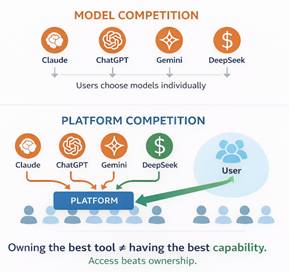 No single AI model is best at everything. Anyone who has used more than one of them already knows this instinctively.
Claude tends to be sharper on structured reasoning and code. ChatGPT has a natural storytelling fluency. Perplexity synthesises real-time information with unusual elegance. DeepSeek offers cost-effective reasoning that makes enterprise procurement teams considerably less anxious.
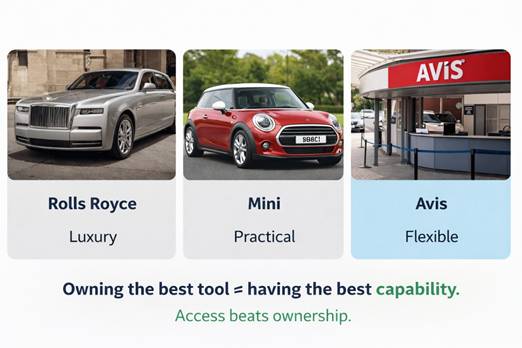
Think of it this way: what is the best car? A Rolls Royce, or a Mini? The answer is, of course, that it depends entirely on your use case, and if your use cases are varied and diverse, you don’t buy a car at all. You rent whichever model suits the journey.
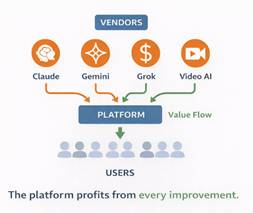 This is not a problem waiting to be solved. It is a permanent feature of the landscape. Specialisation is not a temporary market inefficiency on the way to one model ruling everything. It is the destination.
Which means the company that builds the routing layer — the intelligent orchestration platform that assigns tasks to whichever model handles them best and takes a margin on the transaction regardless — is in a structurally superior position to any company still competing solely on benchmark performance.
In platform economics, the marketplace owner tends to outperform the best vendor on the marketplace.
Amazon does not make the best of everything it sells. Stripe does not process every payment through its own infrastructure. They profit because they control the layer through which transactions flow.
I wrote this analysis down. I shared it with no one of consequence. I moved on.
On the 25th of February 2026, Perplexity launched Computer.
What Perplexity Computer Actually Is
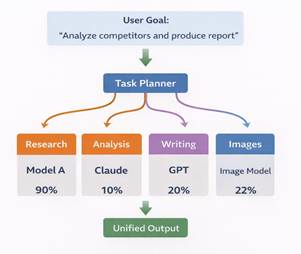 Computer is not a chatbot upgrade. It is not a search enhancement. It is a multi-agent orchestration platform that accepts a high-level goal, breaks it into components, and routes each component to whichever of nineteen AI models is best suited to handle it. Claude Opus for reasoning and code. Gemini for deep research. Grok for lightweight tasks. Specialised models for images and video.
The user never needs to think about which model to use. That is Perplexity’s job now.
The platform maintains persistent memory across sessions, runs tasks autonomously in the background, and delivers a unified output. It is available to Max subscribers at $200 a month, with enterprise rollout confirmed as imminent.
Perplexity is not alone in exploring this direction. Open-source and locally hosted orchestration platforms such as OpenClaw already demonstrate that multi-model routing and persistent agent workflows can be implemented outside commercial subscription platforms. The difference is not conceptual but operational. Perplexity is offering a turn-key service, with reliability and security as part of the contract. For many organisations, that is an attractive proposition.
Perplexity has, in other words, built the platform solution I spent a January afternoon explaining to an AI.
I find this enormously encouraging. Not because it validates my analysis (the analysis was fairly straightforward; the strategic logic was not especially hidden), but because of what the timing tells us.
The More Interesting Point
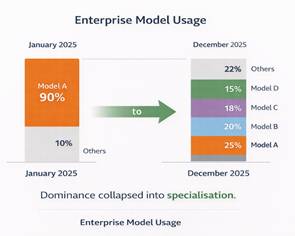 Perplexity’s internal data, shared at a recent press briefing, revealed something striking.
In January 2025, more than ninety percent of enterprise tasks on their platform used just two models.
By December of the same year, no single model commanded more than twenty-five percent of usage. A new frontier model emerged on average every seventeen and a half days last year, and each one brought distinct strengths rather than uniform improvement across all tasks.
The market moved faster than most people expected. Specialisation accelerated rather than resolved itself. And the implication is now inescapable: the aggregation layer is the strategic prize. Not the best model. The best place to access all of them.
The company that builds that, and builds it well, will profit from every improvement any competitor makes. A better Claude is not a threat to the platform; it is an enhancement to the platform’s offering. This is a fundamentally more defensible position than competing on benchmark performance alone, where today’s leader is perpetually vulnerable to tomorrow’s release.
What This Has To Do With You
If you are an L&D professional, a strategist, or anyone who thinks about how organisations create and capture value, there is a transferable principle here worth sitting with.
The question is rarely “how do we become the best?” The more durable question is “how do we become the layer through which value flows?”
The best model competes. The platform profits from competition.
I do not know whether Perplexity will execute this well enough to hold the position. There are real risks: the copyright lawsuits are not trivial, the synthesis technology is genuinely difficult, and if the models themselves become sufficiently commoditised the routing advantage narrows.
But the strategic direction is sound. And it was sound in January.
Sometimes the most useful thing you can do is write the obvious thing down clearly enough that you notice when someone ships it.